Novensia
Novensia is a brand operating system in active development. The brand foundation — mission, pillars, visual guidelines — becomes the source of truth that powers everything downstream, from content production on out. It's built for the people who are their own brand and the agencies, coaches, and consultants who build brands for others. Building the brand's visual identity is a separate part of the same system. I run it by hand for now, on purpose: it stays manual until it's earned the trust to run on its own, with my judgment as the check until it does.
Novensia is a working name. The product is what matters right now.
The problem
Building a brand is hard. Not because consistency is hard — consistency comes with time. It's hard because brand-building asks you to be ten specialists at once: strategist, writer, designer, content producer, marketer. Most people who need a brand aren't any of those things. They're founders, coaches, consultants, small business owners. They know their work. They don't know whether they need a brand pillar, how to word a mission so people take it seriously, whether to start with colors or a design system, or how to produce a YouTube video from a blank script.
The existing tools don't help because they're feature-level. A logo maker. A palette generator. A content tool. A template library. None of them answer the real question: where do I start, and how do I know I'm doing this right?
AI was supposed to fix this. Instead, it made it worse. People ask an AI for a brand mission and get soulless output — because there's no foundation underneath. No real understanding of who they are, what they stand for, or how they sound. And audiences are getting wise to it. The market is actively turning against AI output that has no soul.
Novensia is built on the opposite premise: foundation first. The system learns who you are, grows with you, and uses multiple models checking each other's work so what comes out isn't generic — it's actually you.
The system
Novensia is built in three layers, on purpose, in order.
First, the foundation. A guided intake — seven chapters that walk you through who you are, what you believe, who you serve, how you want your brand to look and sound. Not a form. A conversation with structure. Helper text on every question, because nobody should be left staring at "describe your brand voice" with no idea where to start. Autosave on every keystroke, because these answers take real thought and nothing's worse than losing a paragraph you just figured out how to write. Freely navigable chapters, because the work doesn't always come out in order. It's a capture instrument by design — no AI synthesis here yet, on purpose. You can't make sense of what you haven't said clearly first.
Then the production tools. The brand voice engine is the first one — a four-stage pipeline that learns how you write from your samples, builds a strategy for what you want to say, generates a draft, then runs a tough quality check on its own output before handing it to you. That last part matters. Most AI tools give you the first thing the model thinks of. The voice engine writes a draft, then puts a second model in the room whose only job is to find what's wrong with it — measured against your voice and against the strategy. The version you see has already been argued with.
Underneath, the choices are deliberate. Sonnet 4.6 handles the fast creative work — voice analysis, strategy, drafting — at temperatures 0.2, 0.4, and 0.7 respectively. Cool and analytical when the system is learning your voice. Warmer when it's writing for you. Opus 4.8 handles the quality check at 0.2 — cool again, because judgment needs to be sharper than invention. The right model and the right temperature for what each stage is actually doing.
One detail worth pulling out: the voice profile captures techniques, not phrases. Most "trained on your voice" tools just remix sentences from your samples — which is why they sound like a karaoke version of you. Novensia learns how you make a point, not the exact words you used to make it last time. The difference shows up in the writing.
And the third layer — the synthesis layer — is what's coming next. This is the piece that fuses the foundation with the tools. So when the voice engine writes, it's not just pulling from your samples — it's pulling from your mission, your pillars, the people you serve, everything the intake captured about who you actually are. The runway for this is already built. The schema reserves space for it. It ships next.
Everything attaches to a shared brand record. Intake and voice engine aren't steps in a sequence — they're siblings. You can use one, the other, or both. But the brand is always the source of truth. And it grows as you give it more.
What it feels like to use
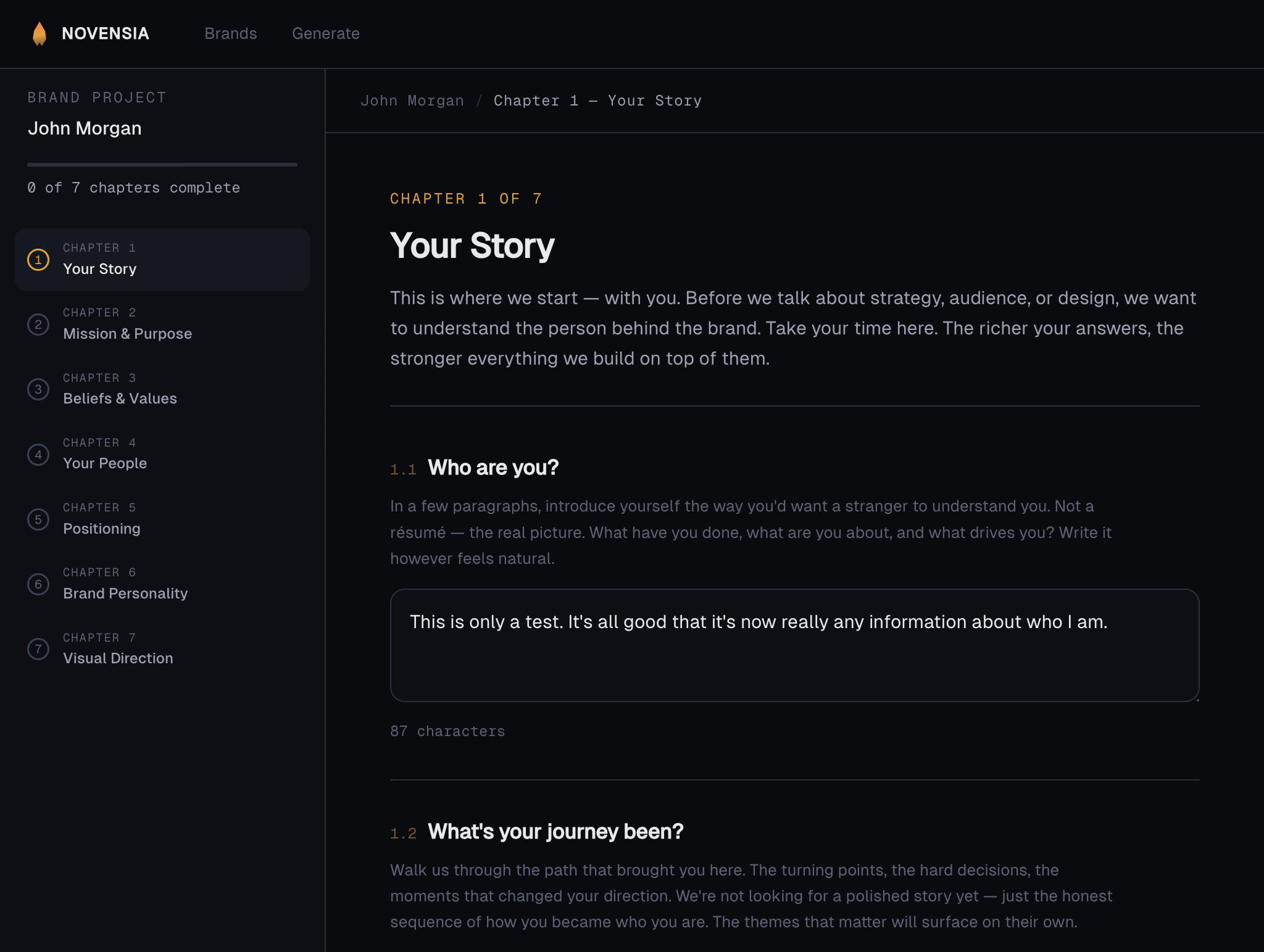
Branding is storytelling. Every brand worth anything is a story someone is telling about themselves — to their people, to the world, to the customer trying to decide if this is for them. So Novensia is built in chapters. Not because chapters are a clever metaphor, but because that's actually what's happening: you're writing the story of your brand, in order, one piece at a time.
The intake doesn't show you a blank canvas. Brand work all too often dies on a blank canvas. You sit down to "define your mission" and twenty minutes later you've made a sandwich, checked your email twice, and written nothing. Novensia removes that moment. Every question has helper text. Every chapter has an intro that frames what you're about to work on. The system has a point of view about where to start, what to think about, and what good looks like — not to put words in your mouth, but to give you something to push against. Most people don't need a blank page. They need a thoughtful question and somewhere to start writing.
Autosave on every keystroke. No save button. You can't lose work. Walk away in the middle of chapter four and come back in three days — you'll land where you left off, with everything you wrote still there. The system trusts you to come back, and it doesn't punish you for taking the time you needed.
And then, at the end, something quiet and significant happens. You've actually written it down. Your mission. Your pillars. Who you serve. What you believe. How you sound. The thing you've been carrying around in your head for years, half-articulated, is suddenly outside your head — readable, structured, real. Blood, sweat, and tears, without the blood and the tears. There it is. Your brand. On paper. That's what the whole product is designed to deliver. Not a logo. Not a tagline. The deeper thing underneath both of those, which most people never get to because the work feels too hard to start.
That's the product. The architecture serves the feeling. The design serves the feeling. The AI, when it shows up later, serves the feeling. Everything is in service of the moment someone realizes they did it.
What I built
Novensia is at the stage where one person is doing all of the work. Strategy, architecture, prompt engineering, design system, intake design, copy, database schema, build — everything that's shipped so far has come from a single set of hands. That's a scope decision more than anything else. Going solo at this stage has let the product stay coherent — the architecture informed by the design, the design informed by the copy, the copy shaped by what someone is actually feeling when they sit down to write a mission statement. Every layer has been able to reach back into the others and adjust them. That's harder to do when the work is split across roles, and it's part of why Novensia hangs together the way it does.
Where it's going
Two things are next.
The synthesis layer — the piece that connects the foundation to the production tools. Right now the intake knows who you are and the voice engine knows how you write, but they don't talk to each other. Synthesis closes that gap, so generated content is grounded in your mission and pillars, not just your writing samples. The schema's already built for it.
RAG — so the voice engine can learn from far more than a handful of samples. A backlog of posts, a book, years of emails. More to learn from, a sharper read on the voice.